
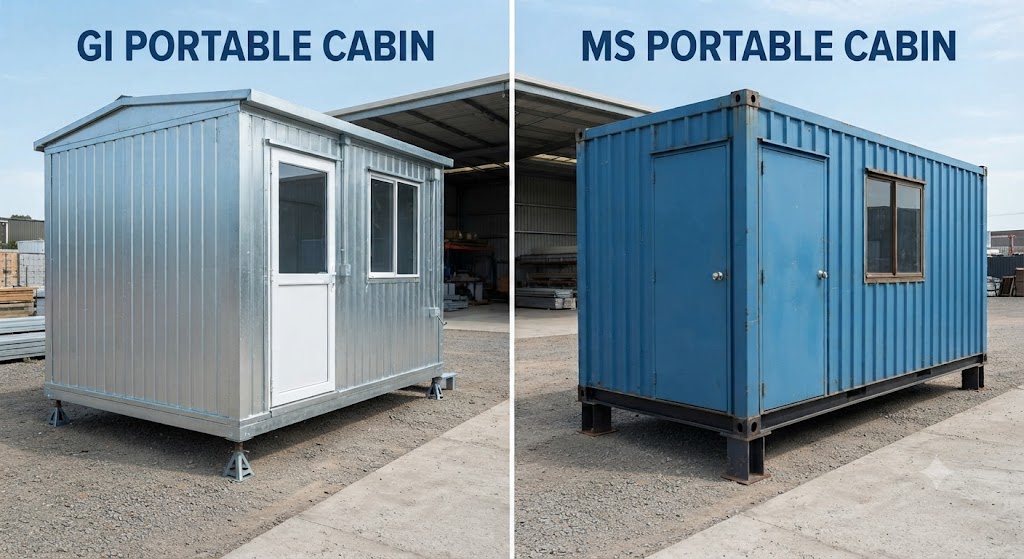
Choosing the right material is one of the most important decisions when buying a portable cabin. At first glance, GI and MS portable cabins may look almost the same. Both can be used for offices, security cabins, accommodation, stores, construction sites, and industrial applications.
However, the material used for the structure can affect corrosion resistance, maintenance, cost, durability, and suitability for different locations.
This is especially important in India because a portable cabin may be installed in a dry industrial area, a coastal location, a high-humidity region, or an outdoor construction site.
So, should you choose a GI portable cabin or an MS portable cabin?
The answer is not simply about which material is stronger or better. The right choice depends on where the cabin will be installed, how long you plan to use it, the surrounding environment, maintenance requirements, and your budget.
In this guide, let's understand the difference between GI and MS portable cabins and find out which option makes more sense for your project.
What Is an MS Portable Cabin?
MS stands for Mild Steel. MS portable cabins are built using mild steel sections or sheets as part of their structural system.
Mild steel is widely used because it is strong, easy to fabricate, and comparatively economical. It can also be welded and customized according to different cabin designs.
MS portable cabins are commonly used for:
MS remains a popular choice for standard portable cabin applications because it provides a good balance between strength and cost. However, exposed mild steel needs suitable surface protection such as primer and paint to reduce corrosion.
What Is a GI Portable Cabin?
GI stands for Galvanized Iron. In practical construction applications, GI generally refers to steel protected with a zinc coating.
The zinc coating provides additional protection against corrosion. It acts as a protective layer and helps shield the underlying steel from moisture and environmental exposure.
This makes GI particularly useful where the cabin will face:
Research comparing atmospheric corrosion behaviour in India has found galvanized materials to be considerably more durable than mild steel under several exposure conditions.
A GI portable cabin can therefore be a sensible choice when corrosion protection is an important requirement.
GI vs MS Portable Cabin: What Is the Main Difference?
The simplest way to understand the difference is this:
MS provides a strong and economical steel structure, while GI adds zinc-based corrosion protection to the steel.
The structural strength of a cabin does not depend only on whether it is GI or MS. The frame design, steel thickness, sections, joints, workmanship, insulation, flooring, and overall engineering also matter.
The major difference for buyers is usually corrosion protection and maintenance.
This is why the location of your project should play an important role in your decision.
1. Corrosion Resistance
This is where GI has its biggest advantage.
Mild steel can develop rust when it is continuously exposed to moisture and oxygen. Proper painting and surface treatment can significantly reduce this risk, but maintenance is still required.
GI steel has a zinc coating that provides an additional layer of protection.
This makes GI more suitable for environments where moisture is a regular concern.
For example, if you are installing a cabin near the coast or in an area with frequent rainfall, GI can offer better protection against corrosion.
Which is better?
GI is generally the better choice for corrosion-prone environments.
For dry and normal inland conditions, properly treated MS can be a practical and economical option.
2. Strength and Structural Performance
Many buyers assume that GI automatically means stronger steel.
That is not necessarily correct.
The structural performance of a portable cabin depends on factors such as:
GI and MS can both be used effectively in portable cabin construction.
MS is widely used for structural frames because it is easy to fabricate and weld. GI can provide additional corrosion protection, but the zinc coating itself should not be treated as a guarantee of greater structural strength.
Which is better?
For structural strength, don't choose only based on GI or MS.
Ask the manufacturer about the frame specification, steel thickness, structural design, and intended load.
3. Maintenance Requirements
Maintenance is another important difference.
An MS cabin installed outdoors may require periodic inspection and repainting to maintain corrosion protection.
If scratches, damaged paint, or exposed steel are ignored, rust can gradually develop.
GI reduces this maintenance burden because the zinc coating provides additional corrosion protection.
This can be particularly useful when the cabin is installed in a difficult-to-access location.
Imagine a cabin installed at a remote project site. Bringing workers and equipment back every year for extensive surface maintenance can increase operational costs.
In such situations, better corrosion protection can provide practical value.
Which is better?
GI generally requires less corrosion-related maintenance, especially in humid or outdoor environments.
MS can still perform well when proper surface treatment and maintenance are provided.
4. Cost Difference
Budget is often the deciding factor.
MS portable cabins are generally more economical than comparable GI configurations because GI involves an additional galvanizing process or galvanized material specification.
The exact price difference depends on:
Therefore, there is no fixed GI-versus-MS price difference that applies to every portable cabin.
The important question is whether the additional investment in GI provides value for your site.
Choose MS when:
You have a normal inland project and want to control the initial cost.
Consider GI when:
You expect high moisture, humidity, coastal exposure, or long outdoor deployment.
5. Suitability for Coastal Areas
Coastal environments can be challenging for steel structures because salt-laden air can accelerate corrosion.
If your portable cabin will be installed near the coast, corrosion protection should be considered from the beginning.
GI can be a suitable option for such environments because the zinc coating provides additional corrosion protection.
For coastal projects, you should also discuss:
Which is better?
For coastal and high-humidity locations, GI is generally the preferred option.
The exact specification should still be selected according to the site's exposure conditions.
6. Suitability for Dry Inland Areas
Not every project needs GI.
Suppose you are installing a portable office at an inland construction site with relatively dry conditions.
In such a situation, a properly fabricated and surface-treated MS portable cabin can provide the required strength and functionality without adding unnecessary material cost.
This is where MS can offer excellent value.
A buyer should not automatically pay more for GI if the environmental conditions do not justify it.
Which is better?
For standard inland applications, MS can be the more economical choice.
7. Customization and Fabrication
Portable cabins often require customization.
You may need:
MS is widely used for fabrication because it is easy to cut, weld, shape, and modify.
GI can also be customized, but galvanizing and welding require appropriate handling. Welding galvanized steel requires proper precautions because heating the zinc coating can produce hazardous fumes, and the affected area may require suitable post-weld protection.
Which is better?
For extensive fabrication and customization, MS can be easier to work with.
For corrosion-sensitive applications, GI can still be specified with suitable fabrication practices.
8. Durability and Service Life
The service life of a portable cabin cannot be determined simply by saying "GI lasts longer than MS."
Several factors influence durability:
A well-maintained MS cabin can provide long-term service.
A GI cabin can offer an additional advantage where corrosion is a major concern.
Therefore, think about durability in terms of total construction quality and site conditions, not just the material name.
9. Which Is Better for Construction Sites?
Construction sites often use portable cabins for offices, stores, security rooms, and accommodation.
For a project lasting a few years in a normal inland environment, MS may provide a practical balance between cost and performance.
For a project in a coastal or highly humid environment, GI may be worth the additional investment.
Also consider whether the cabin will be relocated several times. Repeated transportation can cause scratches and surface damage, so the protection system should be suitable for the intended use.
Practical approach:
Normal inland construction site → MS can be suitable
High-humidity or coastal construction site → GI may be preferable
10. Which Is Better for Security Cabins?
Security cabins are often installed outdoors and remain exposed to rain, sunlight, dust, and humidity.
Because of their location, corrosion protection can be important.
A GI security cabin can be a good choice when the cabin will remain outdoors for a long period.
However, MS security cabins remain a practical option when budget is a major consideration and appropriate surface treatment is provided.
For security cabins, also consider:
The material is only one part of the overall specification.
GI vs MS Portable Cabin: Quick Comparison
| Factor | GI Portable Cabin | MS Portable Cabin |
|---|---|---|
| Base material | Steel with zinc protection | Mild steel |
| Corrosion resistance | High | Depends on surface treatment |
| Initial cost | Generally higher | Generally lower |
| Maintenance | Lower corrosion-related maintenance | More maintenance may be required |
| Coastal areas | Highly suitable | Requires good protection |
| Humid areas | Suitable | Suitable with proper treatment |
| Dry inland areas | Suitable | Highly suitable |
| Fabrication | Requires suitable welding practices | Easy to fabricate |
| Customization | Good | Excellent |
| Strength | Depends on frame specification | Depends on frame specification |
| Long-term outdoor use | Excellent with correct specification | Good with maintenance |
| Best advantage | Corrosion protection | Cost-effectiveness |
So, Which One Should You Choose?
The answer depends mainly on your project location and usage conditions.
Choose an MS Portable Cabin If:
Choose a GI Portable Cabin If:
Don't Choose Only Based on Price
It can be tempting to select MS simply because it has a lower initial cost.
But think about the entire period of ownership.
If an MS cabin needs more frequent maintenance in a highly humid environment, the difference in initial price may become less important over time.
Similarly, if your cabin is installed in a dry inland location, paying extra for GI may not provide enough additional value to justify the cost.
The better approach is to ask:
Where will the cabin be installed?
How long will it remain there?
How much moisture will it face?
How often can maintenance be carried out?
How frequently will the cabin be relocated?
These questions will help you select the right specification.
Conclusion
So, GI vs MS portable cabin — which one should you choose?
There is no universal winner.
MS is an excellent choice when you need a strong, customizable, and economical portable cabin for normal site conditions.
GI becomes more attractive when corrosion resistance and reduced maintenance are important, particularly in coastal, humid, or moisture-prone environments.
The right choice should therefore be based on your project conditions rather than simply selecting the more expensive material.
Before ordering, ask your manufacturer about the steel grade, thickness, surface treatment, galvanizing specification, insulation, roofing, flooring, and expected maintenance requirements.
A properly specified cabin will provide better value than simply choosing GI or MS based on price.
In simple terms:
Dry inland site + controlled budget = MS can be the practical choice.
Coastal/high-humidity site + lower corrosion risk = GI can be the better investment.
Frequently Asked Questions
1. What is the difference between GI and MS portable cabins?
An MS portable cabin uses mild steel, while a GI portable cabin uses steel with a zinc coating for additional corrosion protection. The main practical difference is corrosion resistance and maintenance.
2. Is GI portable cabin better than MS?
GI is generally better for humid, coastal, and moisture-prone environments. MS can be a better value for standard inland applications when proper surface treatment and maintenance are provided.
3. Which portable cabin is cheaper, GI or MS?
MS portable cabins are generally more economical than comparable GI cabins. However, the final price depends on size, steel thickness, insulation, fittings, customization, and other specifications.
4. Is MS portable cabin suitable for outdoor use?
Yes. MS portable cabins can be used outdoors when the steel receives suitable corrosion protection and the cabin is properly maintained.
5. Is GI portable cabin suitable for coastal areas?
Yes. GI can be a suitable choice for coastal locations because its zinc coating provides additional corrosion protection. The complete cabin specification should also be selected according to the level of salt and moisture exposure.
6. Which requires less maintenance, GI or MS?
GI generally requires less corrosion-related maintenance because of its zinc coating. MS requires suitable surface protection and periodic inspection, especially when exposed to outdoor conditions.
7. Which is stronger, GI or MS portable cabin?
Neither should be considered automatically stronger. Strength depends on the steel grade, frame sections, thickness, joints, welding, flooring, and structural design.
8. Can an MS portable cabin be customized?
Yes. MS is widely used for customized portable cabins because it is easy to fabricate and weld. Doors, windows, partitions, electrical points, and other features can be incorporated according to the project.
9. Is GI worth the additional cost?
GI can be worth the additional investment when the cabin is exposed to humidity, rain, coastal air, or difficult maintenance conditions. For dry inland projects, MS may provide better cost efficiency.
10. Which one is better for a construction site?
For a normal inland construction site, MS can be a practical option. For coastal or highly humid construction sites, GI may provide better corrosion protection.