
When you need a temporary office, site cabin, security room, storage space, or accommodation facility, conventional construction is not always practical. Projects often have tight deadlines, changing site requirements, limited space, and budget considerations.
This is where portable cabins and shipping containers can be useful alternatives.
At first glance, both options may look similar. They can be transported to a site, modified for different purposes, and relocated when required. However, their design, construction, comfort, and applications are different.
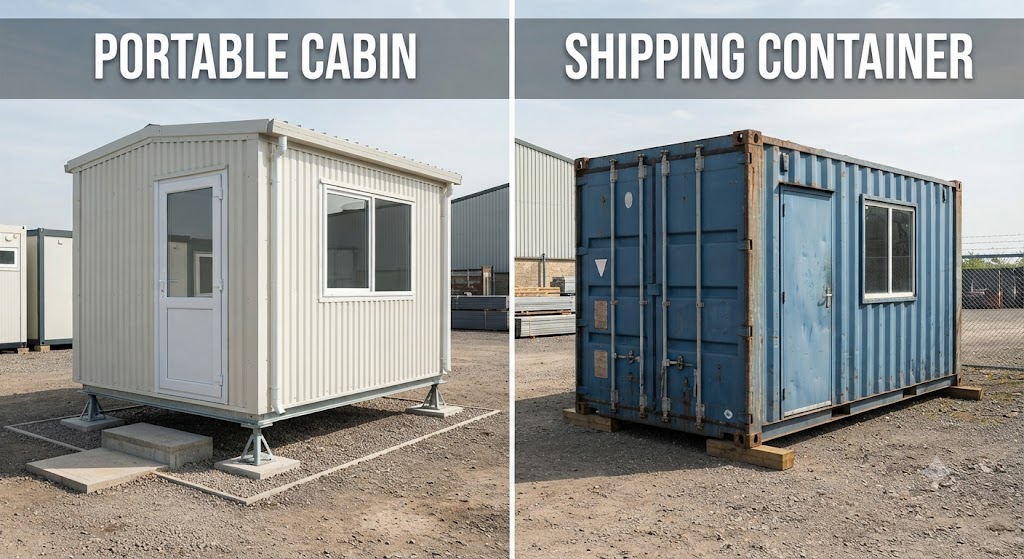
A portable cabin is generally designed as a usable room or workspace from the beginning. A shipping container is originally designed to transport goods and can later be converted into an office, store, accommodation unit, or other facility.
So, which one should you choose?
The answer depends on your application, project duration, budget, comfort requirements, mobility needs, and customization preferences.
In this guide, we compare portable cabins vs shipping containers to help you make a practical decision.
What Is a Portable Cabin?
A portable cabin is a prefabricated structure manufactured for quick installation and relocation. It generally consists of a structural frame, wall panels, roofing, flooring, doors, windows, and other fittings.
Most components are manufactured before the cabin reaches the project site. This reduces on-site construction work and helps businesses get the required space ready in less time.
Portable cabins are commonly used as:
The specifications can be selected according to the application. An office cabin may include insulation, electrical points, lighting, flooring, ventilation, partitions, and air-conditioning provisions.
The biggest advantage is that the cabin can be designed around its intended use.
What Is a Shipping Container?
A shipping container is a steel container originally manufactured for transporting goods. It is designed for handling, transportation, stacking, and exposure to outdoor conditions.
These containers can later be modified for different purposes, including:
Converting a shipping container into an office can involve adding doors, windows, insulation, flooring, electrical wiring, ventilation, ceiling, and interior finishes.
This creates an important difference between the two options.
A portable cabin starts as a building structure, while a shipping container starts as a cargo container.
That difference can influence the final cost, comfort, layout, and suitability for your project.
Portable Cabin vs Shipping Container: Key Differences
The most important difference is their original purpose.
Portable cabins are manufactured primarily for human occupancy and functional space.
Shipping containers are manufactured primarily for cargo transportation and structural handling.
A shipping container can certainly be converted into a comfortable office. However, additional modification work may be required.
A portable cabin may therefore be more convenient when you need a ready-to-use office, security room, accommodation unit, or other occupied space.
A shipping container can be useful when heavy-duty construction, security, storage, or repeated handling is a priority.
1. Construction and Structural Design
Construction is one of the first factors to consider.
Portable cabins generally use a structural frame with wall and roof panels. The exact construction depends on the manufacturer, application, and required specifications.
Shipping containers use a strong steel structure designed for transportation and stacking.
This makes shipping containers useful for demanding applications where the unit may need repeated lifting and handling.
For a standard office or security cabin, however, a purpose-built portable cabin can be more practical because it is designed around the required room function.
Which is better?
For a normal office, site cabin, or security cabin, a portable cabin can be a practical choice.
For heavy-duty storage and repeated lifting, a shipping container may have an advantage.
2. Comfort and Insulation
Comfort becomes important when people will spend several hours inside the structure.
A shipping container has a large steel surface. Without suitable insulation and ventilation, the interior can become uncomfortable in hot weather.
A converted container may therefore require:
Portable cabins can also be designed with suitable insulation and ventilation from the beginning.
For offices and accommodation, this can make the structure more comfortable for daily use.
Which is better?
For occupied spaces, compare the complete insulation and interior specification instead of choosing only based on the outer structure.
A well-designed portable cabin can provide good comfort. A properly converted shipping container can also provide comfortable conditions.
3. Installation Time
Both options can reduce construction time compared with conventional buildings.
Portable cabins are generally manufactured before delivery. Once they reach the site, installation and finishing can be completed quickly.
Shipping containers can also be converted before delivery. However, the conversion may involve structural cutting, insulation, electrical work, flooring, and interior finishing.
The actual installation time depends on the design and customization.
Which is better?
If you need a straightforward ready-to-use space, a portable cabin may provide a simpler solution.
For a customized container office, discuss the complete conversion requirements before ordering.
4. Mobility and Relocation
Many companies choose portable structures because their projects are temporary.
A construction project may operate at one location for several months and then move to another location. In such cases, the ability to relocate the facility becomes important.
Portable cabins can be transported to another site when designed for relocation.
Shipping containers are also well suited to transportation and lifting because their original purpose involves cargo movement.
However, relocation costs can include:
Which is better?
Both options can work for mobile projects.
Before choosing, consider how frequently the structure will be moved and the transportation equipment available at your sites.
5. Space and Layout
Portable cabins can be designed according to the requirements of the project.
For example, an office may require:
These requirements can be incorporated into the cabin layout.
Shipping containers have standard dimensions. Common options include 20-foot and 40-foot containers.
Their standard shape can be useful for modular applications, but it can also restrict the internal width and layout.
Which is better?
For application-specific layouts, portable cabins can offer greater flexibility.
For standardized modular spaces, shipping containers can be a suitable choice.
6. Security
Security is an important factor for industrial and construction sites.
Shipping containers have a strong steel shell, making them useful for secure storage and certain site applications.
However, an office or security cabin needs more than strong walls. You also need to consider:
Portable cabins can also be equipped with suitable security features.
For a security guard cabin, visibility and comfort may be more important than having a completely enclosed steel structure.
Which is better?
For secure storage, shipping containers can be highly suitable.
For manned security cabins, a purpose-built portable security cabin may provide better visibility and functionality.
7. Customization
Customization is another important consideration.
A portable cabin can be designed with:
Shipping containers can also be customized. However, modifications must consider the original structural design.
Cutting openings or making major changes should be handled carefully to maintain structural integrity.
Which is better?
For highly application-specific requirements, a portable cabin can be convenient.
For container-based modular structures, shipping containers provide several customization possibilities when properly engineered.
8. Portable Cabin vs Shipping Container Cost
Cost is one of the first questions most buyers ask.
However, there is no single price for either option.
The final cost depends on:
A basic shipping container may appear cheaper than a finished portable office cabin.
But the comparison changes when you add conversion costs.
A container may require:
Container + transportation + cutting + insulation + flooring + electrical work + doors + windows + interior finishing + installation
A portable cabin may already include several of these features as part of its factory-built specification.
Therefore, compare the complete usable solution, rather than comparing only the initial structure price.
9. Maintenance Requirements
Both portable cabins and shipping containers require regular maintenance.
Portable cabins may need periodic inspection of:
Shipping containers also need inspection, especially when exposed to moisture and outdoor conditions.
Rust prevention is particularly important for steel structures.
The quality of construction, material selection, installation, and maintenance will have a significant impact on service life.
Which is better?
Neither option automatically wins.
The right choice depends on the quality and specification of the structure.
10. Which Is Better for Construction Sites?
Construction sites often need multiple temporary facilities.
These may include:
A portable cabin can be a practical choice when you need a comfortable and functional workspace that can be installed and relocated.
A shipping container can be useful for secure storage, rugged applications, and container-based site offices.
The decision should consider project duration, workforce, site conditions, mobility, and required facilities.
Portable Cabin vs Shipping Container: Quick Comparison
| Factor | Portable Cabin | Shipping Container |
|---|---|---|
| Original purpose | Building/occupied space | Cargo transportation |
| Office use | Excellent | Good after conversion |
| Customization | High | High with structural limitations |
| Comfort | Can be designed for comfort | Requires proper conversion |
| Mobility | Suitable for relocation | Excellent for handling |
| Security | Good with suitable features | Strong steel structure |
| Installation | Quick | Quick after conversion |
| Insulation | Can be included | Usually requires addition |
| Layout flexibility | High | Moderate |
| Storage | Good | Excellent |
| Long-term use | Suitable | Suitable |
| Construction sites | Excellent | Excellent |
Which One Should You Choose?
There is no universal winner.
Your project requirements should decide the better option.
Choose a Portable Cabin If:
Choose a Shipping Container If:
Don't Choose Only Based on Price
A lower initial price does not always mean a lower overall project cost.
Before making a decision, ask:
These questions can change the final calculation.
The best approach is to compare the total delivered, installed, and usable cost of both options.
Conclusion
So, portable cabin vs shipping container — which is better for your project?
The answer depends on your specific requirements.
A portable cabin can be an excellent choice when you need a comfortable, functional, customizable, and quickly installed space.
A shipping container can be suitable when you need a strong steel structure, secure storage, repeated transportation, or a container-based modular solution.
For an office, focus on comfort and layout.
For storage, focus on security and durability.
For accommodation, focus on insulation and ventilation.
For relocation, consider transportation and lifting requirements.
And for any project, compare the complete solution instead of looking only at the basic purchase price.
The right choice is the one that provides the best balance of cost, comfort, durability, mobility, customization, and long-term value for your project.
Frequently Asked Questions
1. Is a portable cabin better than a shipping container?
A portable cabin can be better for offices, accommodation, security rooms, and other occupied spaces. A shipping container can be better for secure storage and heavy-duty applications. The right choice depends on your project requirements.
2. Which is cheaper, a portable cabin or a shipping container?
The initial price can vary based on size and specifications. A shipping container may appear cheaper initially, but conversion costs for insulation, flooring, electrical work, doors, windows, and interiors can increase the final cost.
3. Can a shipping container be used as an office?
Yes. Shipping containers can be converted into offices by adding insulation, doors, windows, electrical systems, flooring, ventilation, and other required facilities.
4. Are portable cabins suitable for construction sites?
Yes. Portable cabins are commonly used for construction site offices, security cabins, stores, accommodation, meeting rooms, and other temporary facilities.
5. Which option is easier to relocate?
Both portable cabins and shipping containers can be relocated. Shipping containers are specifically designed for transportation and lifting, while portable cabins can also be designed for easy movement between project sites.
6. Are shipping containers comfortable for office use?
They can be comfortable when properly converted. Insulation, ventilation, windows, flooring, ceiling treatment, lighting, and air-conditioning provisions should be considered for regular office use.
7. Can portable cabins be customized?
Yes. Portable cabins can be customized according to size, layout, insulation, flooring, doors, windows, electrical requirements, partitions, and other project needs.
8. Which is better for secure storage?
Shipping containers can be a strong choice for secure storage because of their steel construction. Additional locks and security features can further improve security.
9. How long can a portable cabin be used?
The service life depends on construction quality, materials, installation, environmental conditions, usage, and maintenance. A properly manufactured and maintained portable cabin can be suitable for both temporary and long-term applications.
10. What should I consider before buying a portable cabin or container?
Consider the intended use, size, budget, project duration, insulation, layout, security, transportation, installation, customization, maintenance, and future relocation requirements.